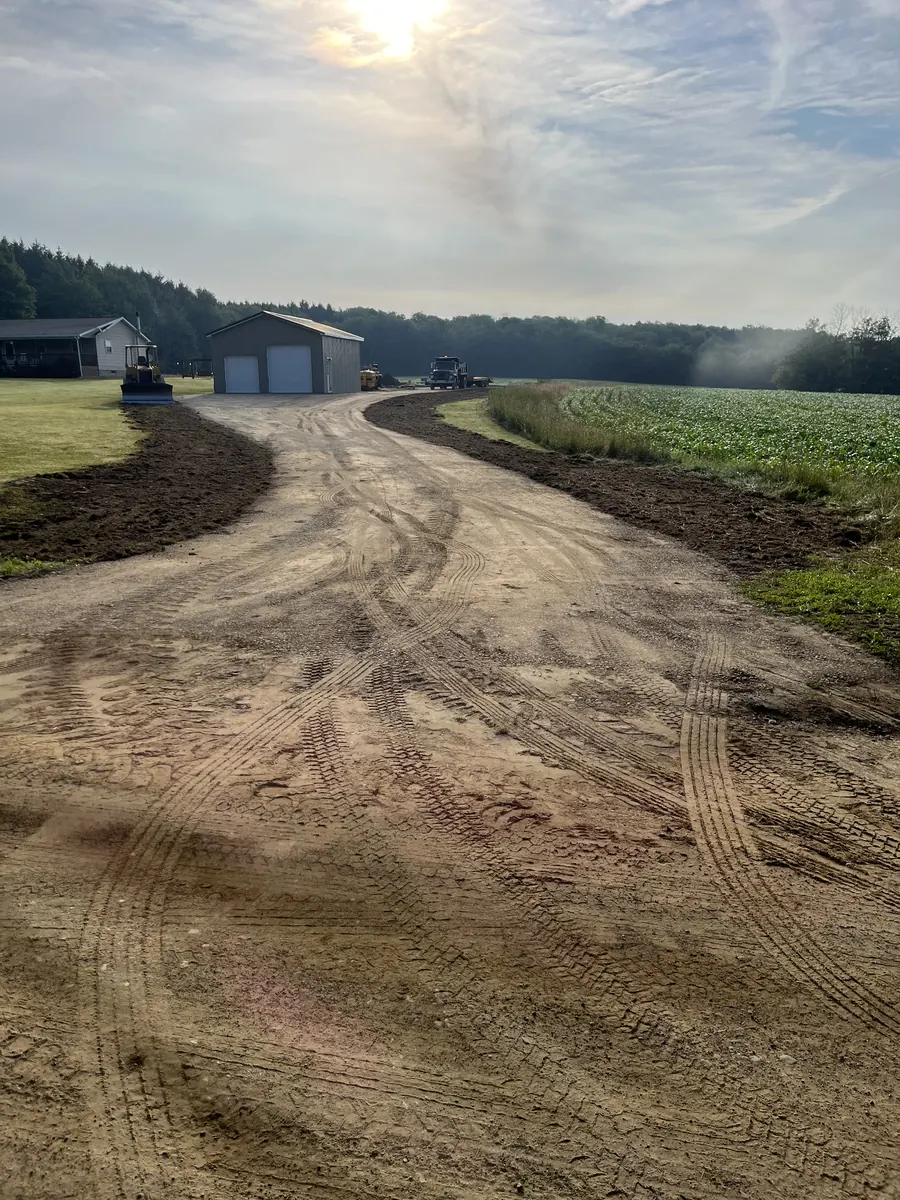
A gravel driveway that holds up through a Rochester mud season starts well below the surface. Here is what goes into one that drains, stays firm, handles the plow, and does not wash out.
A gravel driveway is one of the most practical things you can build on a rural or semi-rural property. It is easy to maintain, it handles heavy trucks and equipment, and it can be extended or reshaped later. But a gravel driveway is only as good as what is under the stone you see. Most failed gravel driveways around here were not short on stone on top. They were short on preparation underneath and on a plan for water.
This is what goes into a gravel driveway that lasts through Rochester winters and spring thaws.
Why Gravel Driveways Fail
It helps to know what goes wrong before talking about how to do it right. The usual problems are:
- Stone spread on topsoil. Organic soil compresses and holds water. Stone pushed into it turns into ruts and mud.
- No base layer. A thin layer of surface stone on soft ground cannot carry a loaded truck.
- Water sitting on or under the driveway. Standing water softens the base, and in winter it freezes and heaves.
- No crown. A flat or dished driveway holds water or channels it down the center.
- Blocked or missing culverts. Water that cannot cross under the driveway goes over it and washes stone away.
Almost every one of these is a water problem or a base problem. Fix those, and the surface takes care of itself.
Plan the Route Around Water
Where water goes is everything. Before any digging, walk the route after a good rain and look at where water runs and where it sits. A good route:
- Follows the natural lay of the land where possible
- Avoids low spots that collect water, or raises the driveway up through them
- Stays off the bottom of slopes where runoff concentrates, when there is a choice
- Leaves room for ditches or swales alongside
- Includes culverts where the driveway crosses a drainage path
- Keeps grades reasonable so vehicles can make it up in snow and ice
Also think about how the driveway will be used. Delivery trucks, a fuel or propane truck, farm equipment, or a camper all need room to turn and enough width at the curves.
Check Permits and the Road Connection
Where the driveway meets the road matters. Connecting to a public road usually requires permission from whoever owns the road, which could be your town, the county, or the state highway department. They may have rules on the location, width, sight distance, and the size of the culvert under the driveway entrance. Your town may also have its own rules on driveways, drainage, and grading. Check with them before work starts. If the driveway route crosses a stream or wet area, certain streams and wetlands are regulated by the NYS DEC, and Region 8 covers the Rochester area.
Before any digging, call 811 through Dig Safely New York, generally at least two full working days ahead not counting weekends and holidays. Our post on calling 811 and preparing your property covers what to expect.
Clear the Route and Strip the Soft Stuff
On a wooded property, the first step is land clearing along the route: trees, brush, and stumps. Stumps and roots left under a driveway will rot and leave soft spots.
Then the topsoil and organic material come off, down to firmer subsoil. Spreading stone on top of topsoil is the most common reason driveways rut and turn to mud. The stripped topsoil can be saved and used to dress the shoulders and ditches so they grow grass and hold up against erosion.
Build a Solid Base
The base layer is the backbone of the driveway. It carries the load and spreads it out over the soil below.
Shape the Subgrade
Before any stone goes down, the subgrade is shaped and graded so it already has the crown and drainage the finished driveway will have. Soft spots are dug out and replaced instead of buried.
Use Fabric Where the Ground Is Soft
In soft, wet, or clay areas, a geotextile fabric between the soil and the stone helps keep the base from sinking into the ground and keeps fine soil from pumping up into the stone over time. It is not needed everywhere, but in wet ground it makes a real difference.
Place Base Stone in Lifts
Larger, angular crushed stone locks together and carries the load better than round stone. The base is spread and compacted in layers rather than dumped all at once. How thick the base needs to be depends on the soil, the drainage, and what will be driving on it. A driveway for a pickup truck and a driveway for loaded farm equipment are different jobs.
Add a Surface Layer
On top of the base goes a finer surface stone that packs down into a firm, smooth driving surface. Material that includes a mix of stone sizes and fines, often called crusher run or a similar name depending on the supplier, compacts better than clean stone and is less likely to shift under tires or get pushed around by a plow. Clean, round stone looks nice but rolls and moves, so it is better used for landscaping than for a working driveway.
Crown, Ditches, and Culverts
The finished driveway should be slightly higher in the middle than at the edges, called a crown, so rain and snowmelt run off to the sides instead of sitting on the surface or running down the center. On a hillside, a cross slope can do the same job.
That water then needs somewhere to go:
- Ditches or swales along the sides carry water away from the driveway.
- Culverts let water cross under the driveway where it follows a natural drainage path. They need to be big enough, set at the right grade, and covered with enough material that they do not crush.
- Turnouts at intervals on long or steep driveways move water off before it builds up and starts cutting the surface.
Standing water is what turns a good driveway into a pothole-filled one.
What Rochester Weather Does to a Driveway
The Rochester area is hard on driveways, and a few local conditions are worth planning for.
- Freeze-thaw cycles. Water that gets into the base freezes, expands, and heaves the driveway, then softens it when it thaws. Good drainage keeps water out of the base in the first place.
- Mud season. The spring thaw saturates the ground. A driveway with a thin base on soft soil is at its weakest then, and heavy trucks in April can do a lot of damage.
- Heavy clay. In lake-plain towns like Hamlin, Parma, Greece, and Webster, clay holds water and drains slowly. Fabric, a thicker base, and good ditches matter even more there.
- Stony till and hills. In the drumlin country south and east of the city, around Mendon, Pittsford, Perinton, and Victor, the ground is often firmer and stonier, but slopes bring runoff and washout concerns.
- Lake-effect snow and plowing. Plow blades scrape stone off the surface and push it into the lawn. A well-compacted surface with good fines holds up better. Setting the plow blade or shoes a little high helps too.
Maintain It
Even a well-built gravel driveway needs some care. To keep it in shape for years:
- Regrade every so often to restore the crown
- Fill potholes and low spots early, before they spread
- Keep ditches and culverts clear of leaves, sediment, and debris
- Add surface stone when the base starts showing through
- Limit heavy loads during the spring thaw when you can
You can see a recent job in our gravel driveway project, where a new driveway was cut in, graded, and finished up to an outbuilding.
Frequently Asked Questions
How Thick Should a Gravel Driveway Be?
It depends on the soil, the drainage, and the traffic. Soft clay and heavy trucks call for a thicker base than firm ground and passenger cars. We size the base to the site after looking at it.
Is Fabric Needed Under a Gravel Driveway?
Not always. In firm, well-drained ground it may not be necessary. In soft, wet, or clay soils, fabric helps keep the stone from sinking and mixing with the soil below.
Can an Old Gravel Driveway Be Fixed Instead of Replaced?
Often, yes. If the base is mostly sound, regrading, adding stone, and fixing the drainage may be enough. If it ruts and turns to mud every spring, the base usually needs to be rebuilt.
Can a Gravel Driveway Be Paved Later?
Yes. A well-built gravel base is a good start for paving down the road. Ask us about driveway and paving options.
Ready for a Driveway That Holds Up?
Whether it is a new driveway to a house site, a lane to a barn or outbuilding, or an old driveway that turns to mud every spring, we can help. Send us your location, the rough length of the driveway, and a few photos and we will follow up with a quote. You can also read about our site work and excavation services or check our service area.